
Olive About Books
Family Pictures
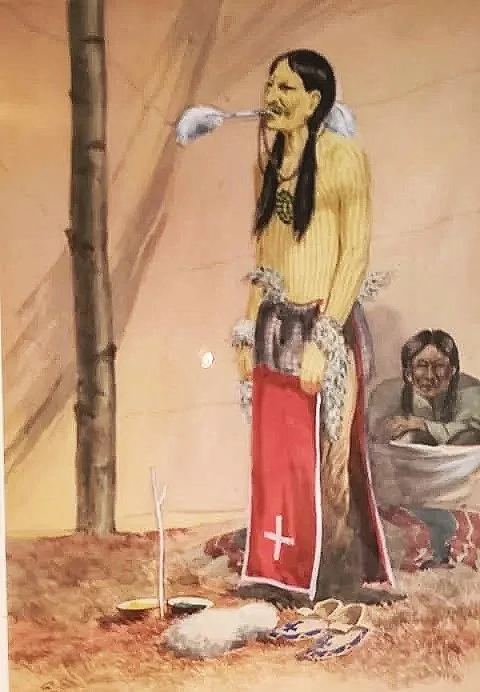
“Sun Dancer,” watercolor, by C. A. Seward
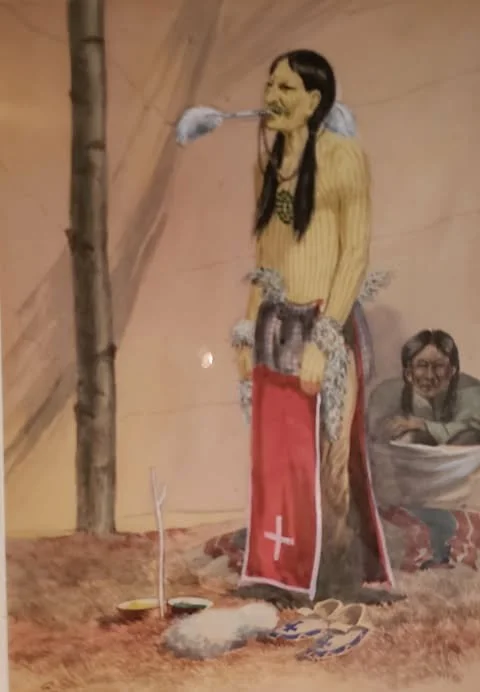
“Sun Dancer,” watercolor by C.A. Sewar
By Olive L. Sullivan
Part of the reason Angel and I decided to open a storefront for Sullivan Book Arts/Wyrd Hoard Letterpress and Photography is that we were outgrowing our houses. SBA started out in the back bedroom of my parents’ house, partly for me to have somewhere to work, and partly so I would have an excuse to check up on them every day. My dad was battling Alzheimer’s and my mom—well, she was battling my dad.
When he died, my mom moved in with me and Angel and her family moved into my parents’ house. The bindery stayed, but bits and pieces made their way to my house, and she added more and more.
One week, we decided to clean out the attic there so she would have somewhere to store her things. See, the house was a repository of history. My parents built in in 1965 when I was 5 years old, and I don’t think they ever threw anything away if it might have a scrap of value. I’m not sure they would qualify as hoarders, but they were certainly thrifty. And the house also contained the legacy of my two grandmothers, Olive K. Sullivan and Helen L. Larson. Olive’s legacy was mostly china and artwork.
She had been an avid collector of art and artists since her girlhood, when her good friend Laura Gillespie decided she would become a famous artist. Mrs. Gillespie, as we kids knew her, is an example of my grandmother’s approach to collecting. She wasn’t worried about provenance and value so much as the emotional connection to the artist through the artwork. One of Mrs. Gillespie’s pieces is a pastel of the ocean near Galveston. They had lived there at the same time, and in spite of the hurricanes that eventually drove them home to Kansas, they loved the memories. Mrs. Gillespie wrote a note on the back of the pastel saying that my grandmother could pay her the value of the painting when she became famous. I don’t think Mrs. Gillespie ever did become famous, but her work was part of the artistic ambiance of my childhood.
My grandmother also had a bridge group, not unusual for women her age. What was unusual is that several of the players were also members of a group called the Prairie Printmakers. This group included Birgir Sandzen, whose work can be seen at the Birgir Sandzen Memorial Gallery in Lindsborg, Kansas, as well as at the Pittsburg State University Alumni Center, PSU’s McCray Hall, and the Pittsburg Public Library. Each year the printmakers made a special gift print for Christmas, and my grandmother left several of those behind in our attic.
C.A. Seward was also a member of the group. Known for his western art, he made prints and painted scenes of Native American life, including this one, Sun Dancer in Full Regalia, which hung in my parents’ bedroom.
“Sun Dancer” was painted by Seward and given to another of the printmakers, Leo Courtney, who then gave it to my father, Frank Victor Sullivan, as a present for high school graduation in 1940. By then, Dad was a collector of Native American art because of his Explorer Boy Scout troop’s interest in what they called Indian dancing. The Seward painting joined a Hopi Kachin that his Scout master gave him, along with pottery, beadwork, and other artifacts he and my mother collected during their courtship and honeymoon in the Southwest. You can read more about my dad’s interest in Native American art and culture and how it affected my philosophy of life and art in my essay, “Souvenirs for My Father,” in The 105 Meadowlark Reader #2, available at 105 Meadowlark Reader.
When I opened my Sullivan Book Arts storefront last June, these collections and treasures were heavy on my mind. The gallery would give us a venue for selling some of the art pieces that had intrinsic value, as opposed to purely sentimental interest. Angel claimed some of the less valuable pieces as examples of the printmaking art and hung them in her workroom in the new building. But the Seward painting caught the attention of Barbara Thompson, an expert on the Prairie Printmakers and the granddaughter of C.A. Seward.
The sale of “Sun Dancer” is the first fruit of my gallery idea, and I love the fact that she is going to donate it to the museum of the University of Oklahoma, which already houses a collection of Seward’s paintings, photographs, and letters from the same period.
I don’t plan to sell every item from Dad’s collection. Some things, like Dad’s turquoise ring (see my poem “Turquoise Ring” in my book Skiving Down the Bones (LINK), I will always keep and wear and treasure. My brother and children have also chosen their favorites to keep. My oldest son Jacob wants the giant Thunderbird drum head Dad’s Boy Scout troops used for their dances. It still hangs on the great room wall at my parents’ house—it’s too big to put anywhere else.
But every now and then, the pressure will mount (I have to have room for my hat collection!), and something will have to go. Another piece of our heritage will make its way to the gallery. Though Dad’s collection may not make us rich or give him a lasting legacy in the big world, we have each chosen our favorite talismans to remember him by. The rest, I hope, will find their way to their destinies, just like “Sun Dancer,” which is going home.
A Brick and Mortar Roost
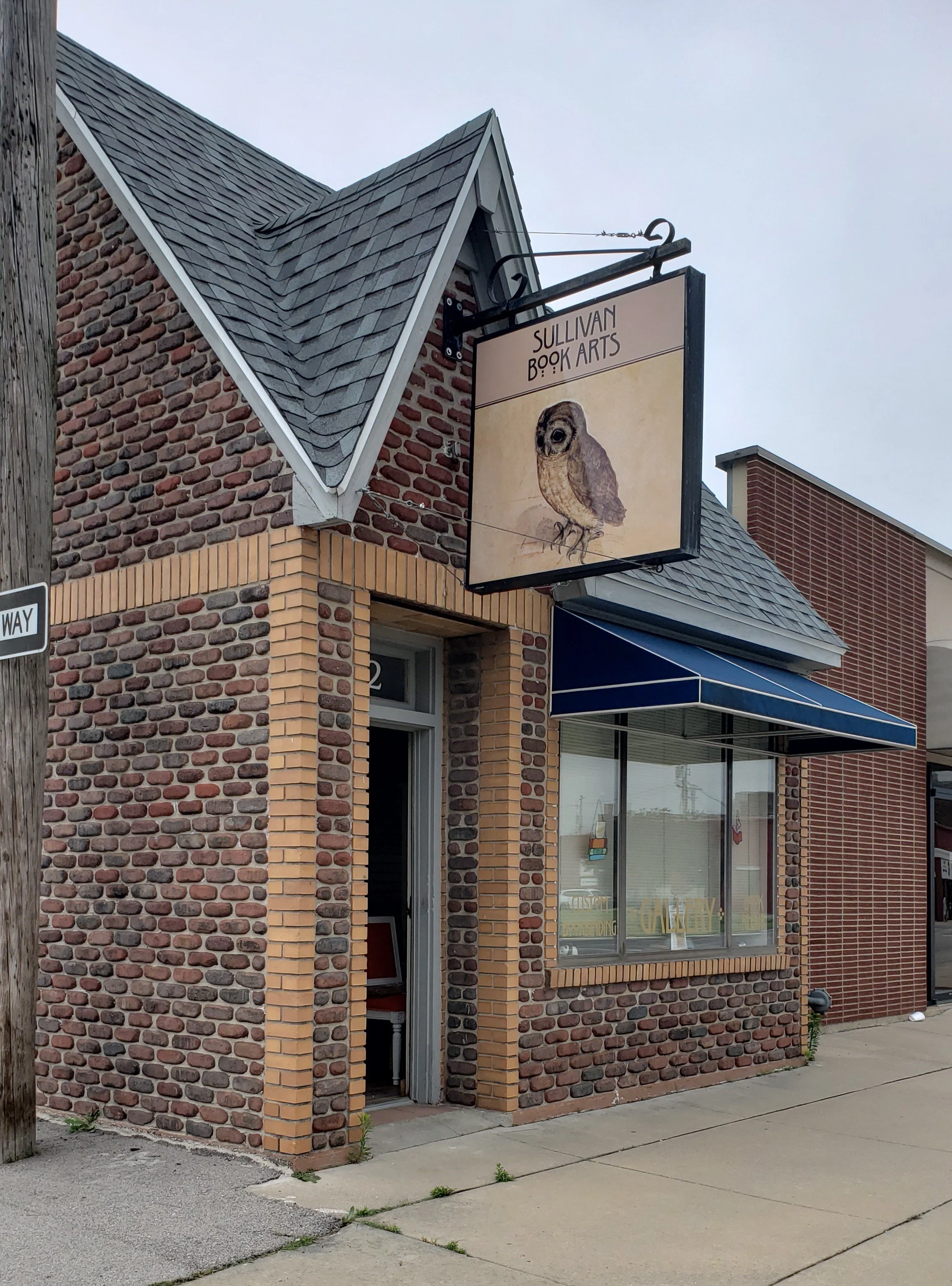
Guys! I’m so excited! We have moved our bindery and letterpress operations into a building in downtown, Pittsburg, Kansas! Up until June, we had been working out of our homes, with the bindery operations spread out over two houses and the letterpress ranging from maker spaces at Pittsburg State University to Angel’s upstairs atelier.
Guys! I’m so excited! We have moved our bindery and letterpress operations into a building in downtown, Pittsburg, Kansas! Up until June, we had been working out of our homes, with the bindery operations spread out over two houses and the letterpress ranging from maker spaces at Pittsburg State University to Angel’s upstairs atelier.
But Angel has graduated with her degree in graphic design (congratulations!), and her house is bursting at the seams. And there is this cute little mock Tudor building right across the road from the Pittsburg Public Library—and it has a fireplace. And a vault. I’ve actually had my eye on it for some time, but once a friend bought it, I swooped in to get first dibs on renting it.
The front room, one of five stretching from front to back, is now a micro gallery that hosts prints and original artwork by local and regional artists, as well as some vintage collectible posters and prints. There are a few other bits and baubles for bibliophiles, including a custom incense scent and a Little Free Library branch.
The next room houses an area where clients can select papers, leather, or cloth for their bookbinding projects or book repairs. Angel’s letterpress equipment sprawls out through that room and the next, and she loves to give demos and take commissions. The fourth room house equipment that we share as well as our break room supplies, and the fourth room, with the fireplace, will be my snug little nest for bookbinding and repairs (and, it turns out, songwriting). One of the first things I bought was a loveseat big enough to take a nap on, because, as a bookbinder with a disability, I occasionally need to lie down while the glue dries.
We plan to offer workshops and occasional Fireside Craft nights where people can come hang out with us and work on their projects or use our materials to come up with something new. Think of it as a bookbinding bee, and my book club meets there once a month.
One of our local artists, Allen Childers, hosts Sketchjams around town, and we’re hoping to get him to showcase our new space for one of them.
We’re still in the process of getting organized even while we work on orders for book repair, custom binding, and letterpress business cards. One of the first tweaks to the space was to order a farmhouse sink so we ean up our inky messes without ruining the landlord’s little vanity. And I love it. It’s the perfect height. We added slatboard for the gallery, shelving and display space, paid licenses and fees, dealt with leaks and cranky antique door locks, oh, more than I can list without bursting into tears. And then came the fun part—welcoming you in to see where we are—and what we do. If you’ve ever said to yourself, “What is bookbinding? What is letterpress?” —well, you probably looked it up, but here’s your chance to check it out in person.
Our first event was a celebration of artists who combine words and images. Featured artists were poets Antjea Wolff and Tasjha Dixon. Antjea, a Pittsburg favorite, does word collage and black-out poetry, while Tasjha, a Kansas City powerhouse, creates what she calls rage poetry. Each artist talked a bit about her process and read a few poems accompanied by music from Kevin Rabas and Ramiro Miranda (drums and violin, respectively), who are part of the group String Daze. We followed that up with an open mic and some snacks. It was a great time. Two people actually said to me, “Wow, it’ s like Pittsburg is becoming the new Lawrence!” Hey, if we can help build a funky arts vibe like Lawrence, I’m all in! Our next artist event will take place this fall, date and time to be announced. The plan is to feature fantasy art (and crows) and spooky stories, songs, and poems. Stay tuned to our Facebook page to learn more.
To hear about special events, please sign up for our newsletter. It comes out monthly (or so), and includes fun tidbits as well as a taste of life between the pages.
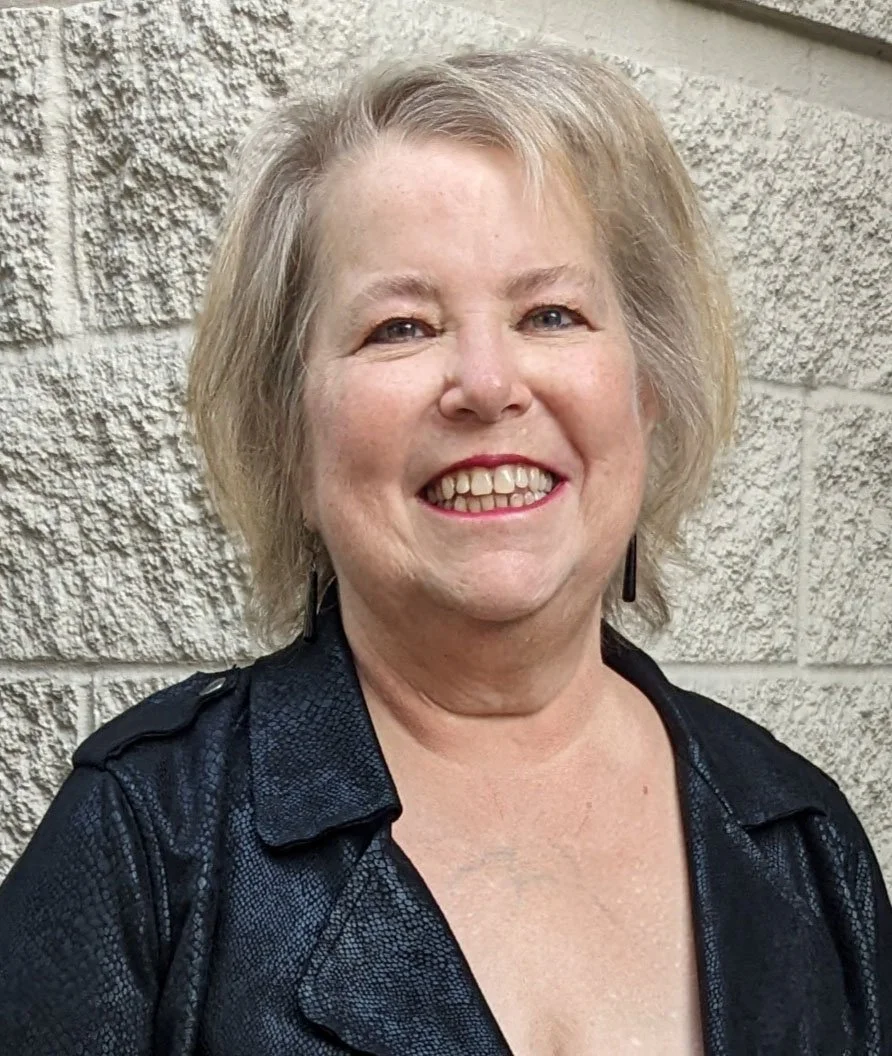
All About Olive: An Interview
Hello! Welcome to Olive About Books, a blog by Olive L. Sullivan, proprietor of Sullivan Book Arts LLC.
I’m Amy, Olive’s sidekick in writing, antiquing, and other shenanigans as assigned. I’m helming this maiden voyage of posts, because who better to introduce you to Olive than the president of her fan club?
Hello! Welcome to Olive About Books, a blog by Olive L. Sullivan, proprietor of Sullivan Book Arts LLC.
I’m Amy, Olive’s sidekick in writing, antiquing, and other shenanigans as assigned. I’m helming this maiden voyage of posts, because who better to introduce you to Olive than the president of her fan club?
Although I’ve known Olive for nearly 20 years, when I sat down to write this, I realized I didn’t know the answers to some of the things I think readers should know. I know her shoe size (7.5) and her stance on the Oxford Comma (pro), but I still have plenty of things to learn about Olive. So we collaborated on the interview that follows.
Q: When did you first know you wanted to be a writer?
A: Stories are what connect people. I come from a long line of storytelling women; stories are part of the fabric of my family. I always knew I wanted to be a writer. I was a passionate reader early on, and that’s part of the training for being a writer. When I was in high school, one of my English teachers told me I was talented enough to become a professional writer, and that solidified it.
Q: What is your educational background?
A: I have a bachelor's degree in English with an emphasis in professional writing and a minor in journalism from Pittsburg State University, a master’s degree in English literature and professional writing from the University of Colorado at Denver, and a master of fine arts degree in poetry and fiction from Stonecoast. Along the way, I took every art class I could fit in. I think education is important, not necessarily to teach a person how to write or do accounting or whatever, but to open one’s mind to different ideas and perspectives, to give them something to write about. I’m a passionate believer in a true liberal arts education that prepares a person to be a better citizen.
Q: What drew you to bookbinding?
A: I’ve always liked to make things, and I love everything about books, from the paper to the binding to the words inside. As a child, I would tell stories and my mother would illustrate them. Once I was able to illustrate by myself, I began creating little books on my own. Although I was trained to make traditional books, I really enjoy making journals with covers that are almost collage; I do a sort of deconstructed image that hints at a bigger picture. They’re almost sculptural artifacts, using my background in drawing and other art media. But it’s important to me that the book inside be a functional book to write in.
Q: What kinds of training did you have to learn the craft of bookbinding?
A: I knew the basics of how to make a book, but I didn’t know how to make a book that looks store-bought.When I started teaching journalism in 2011 at Missouri Southern State University, I received a phone call from bookbinder Sharen May, who said she had the previous year’s bound volumes of the student newspaper, The Chart, ready for pick up. When I walked into her bindery, I swear choirs of angels sang. I thought, “Forget teaching, THIS is it.” Later, I got in touch with her and asked if I could be her apprentice. I worked with her off and on for seven years. During that time, I was diagnosed with leukemia and kidney failure, and spent extended time receiving inpatient and outpatient treatment. There were days when I was so sick my mother would drive me to the bindery and wait while I did what work I could manage. Being there gave me hope for the future when there was good reason to believe I wouldn’t have a future.
Fortunately, I recovered, and, while I didn’t end up buying Sharen’s business as I had hoped, I started a new business with my own flair and focus. The process has been really organic and intuitive. I didn’t draft a business plan, I just saw opportunities and took them. For example, I found that the San Francisco Center for the Book had a week-long intensive workshop scheduled for the week after I had to be there for an unrelated event. There I learned other - and in some cases - much easier ways to do things. Sharen had learned bookbinding from her father, Ralph Drennan, who was self-taught, so I appreciated learning those more efficient techniques. Another example is the new storefront that houses SBA and my partner Wyrd Hoard Letterpress and Photography. We worked out of our homes, but when a building I had been coveting for years was suddenly available, I jumped on it.
Q: What is your vision for Sullivan Book Arts?
A: SBA is an umbrella label for everything Olive.That includes not just writing and bookbinding, but anything that a jack-of-all-trades would do if the trades involve words. I enjoy giving workshops and presentations, and I will read poetry on street corners in the rain, or anywhere else. I’ve worked with all kinds of people - non-traditional learners, former gang bangers, Girl Scouts, medical transcriptionists, and conference participants, among others - helping them tap into the pleasure I get from telling stories and playing with words. As for the store and gallery, my goal is to create community around art and books. I host a monthly book club and schedule artist receptions that I hope come to be “happenings,” like the ones I enjoyed as a child in the 60s.
Q: What is your motto?
A: Have pen, will travel!
To hear more about Olive, Sullivan Book Arts, bookbinding, and other book- and arts-related topics, please tune in for the next installment of Olive About Books.
Cheers!
Amy Nixon
You can read more of my work on my Substack, Write Side Up, at https://amynixon.substack.com/.
You can find Sullivan Book Arts [insert links]